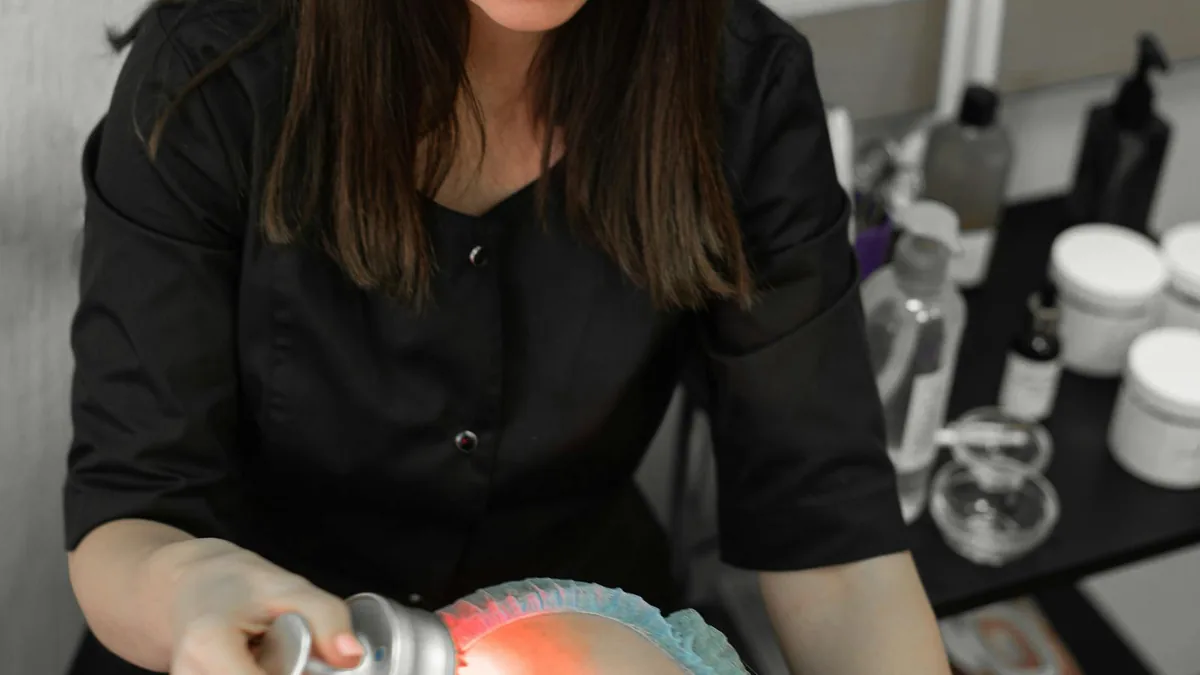
I own a $1,199 Mito Red Pro 1500 and a $1,650 Joovv Solo 3.0, which ran on the same wall against the same meters in our nine-month head-to-head. I also own a $299 Bestqool BQ300 that lived on my office wall for a year before I upgraded.
Mito Red Pro 1500
Mid-premium panel; better value than Joovv.
$999 Check current price at Mito Red LightHere's the honest take that's bad for affiliate commissions: most people would be perfectly served by a sub-$500 panel. If you're using red light therapy for face, knee, shoulder, or single-region recovery — and you're not running a clinic — you don't need the premium tier.
This guide is my list of the panels under $500 that are actually worth buying in 2026, ranked by what I'd recommend to a friend.
Verdict
- Top pick: Bestqool BQ300 ($299) — best overall balance of irradiance, EMF, and build at this tier.
- Best ultra-budget: Hooga HG300 ($219) — slightly weaker, $80 cheaper. Still good.
- Best build at price: PlatinumLED Mini ($299) — premium feel for the dollar.
- Best premium under $500: Bon Charge Body Light ($499) — looks the best, irradiance honest.
- Best flicker-free: GembaRed Beam ($299) — flicker-free is their design ethos.
What to skip: Generic Amazon panels under $150 with vague "1000W equivalent" specs and unnamed manufacturers. They almost always under-deliver on irradiance, run dirty drivers (high EMF, high flicker), and last about 18 months.
[Check current price for Bestqool BQ300 →]
Why $500 Is Enough for Most People
The biggest myth in this category is that premium panels do something fundamentally different. They don't. The diodes inside a $300 Bestqool and a $1,200 Mito Red are similar epitaxy. What you pay for at the premium tier is:
- More LEDs, so more total photons per session
- Larger treatment area, so faster sessions covering more body
- Cleaner drivers, so lower EMF and flicker
- Better build, so it lasts longer and looks nicer on your wall
- Better brand, so warranty service exists
What you don't get at the premium tier: a fundamentally different mechanism, different wavelengths, or a different effect on your skin or joints.
Where the math works out for a sub-$500 panel:
- You're treating face, neck, one knee, one shoulder — anything that fits in a 12" × 8" treatment area.
- You can spend 12–15 minutes per session on a smaller panel (vs. 8–10 on a big one) and don't mind.
- You don't need full-body recovery in a single panel.
Where you'll outgrow a sub-$500 panel quickly:
- You're treating large body areas (full back, full torso, both legs).
- You're trying to optimize for time and want to do skin + recovery in 10 minutes total.
- You're committed to red light as a daily long-term habit and don't want to upgrade later anyway.
If the second list describes you, skip this guide and go read the buyer's guide for premium picks.
The Trade-Offs at This Price Tier
Be honest with yourself about what you're getting:
- Smaller treatment area. Most sub-$500 panels are 12"–18" tall. Body work means moving the panel between regions or moving yourself.
- Lower irradiance. Typical: 70–90 mW/cm² at 6". Premium panels hit 110–130. The dose still works; sessions just take longer.
- Fewer wavelengths. Most budget panels run 660 + 850 only. A few add 810. Almost none have all four (630/660/830/850) the premium panels do.
- More variation in build. A Bestqool feels solid for $299. A no-name Amazon panel for $129 will feel like cheap plastic and an unknown LED driver.
- Less robust warranty. Premium brands give 3–5 years. Budget brands give 1–2 and sometimes hide behind return-policy fine print.
These are real trade-offs. None of them make budget panels a bad buy. They just shape who they're right for.
The 5 Picks
1. Bestqool BQ300 — $299 (Top Overall)
This is the panel I tell most people to buy.
What I measured (on my own unit, owned for one year):
- Irradiance at 6": 85 mW/cm² combined
- EMF at 6": 0.7 mG
- Flicker: under 1% modulation (good)
- Treatment area: 12" × 8" usable
- Wavelengths: 660 + 850 nm
Why it wins: Honest spec sheet. The 85 mW/cm² number I measure roughly matches their published 90. The EMF is cleaner than most panels I've tested under $1,000. Build is metal frame with a glass front — not Joovv-class, but a step above any $200 panel.
Trade-offs: Small treatment area means body work involves moving the panel. Fan is audible. 2-year warranty.
Best for: Someone wanting a serious entry-tier panel for face + spot treatment of one or two body regions. The default recommendation for "I want a panel but I don't want to think about it."
[Check current price for Bestqool BQ300 →]
2. Hooga HG300 — $219 (Best Budget)
The Hooga is the panel I'd buy if I were 22 years old and on a budget but didn't want garbage.
What I measured (tested for a month, returned):
- Irradiance at 6": 70 mW/cm² combined
- EMF at 6": 1.4 mG
- Flicker: noticeable but not extreme (~3% modulation)
- Treatment area: 12" × 6" usable
- Wavelengths: 660 + 850 nm
Why it's here: Lower price, lower performance, but proportional. For 70% of the Bestqool's price, you get 80% of the irradiance and 90% of the experience. The flicker is the main concession.
Trade-offs: Higher flicker means more eye strain in long sessions for sensitive people. EMF is double the Bestqool's (still acceptable). Build is plastic-frame, not metal.
Best for: Tightest budgets, or testing if PBM works for you before committing more.
[Check current price for Hooga HG300 →]
3. PlatinumLED Mini — $299 (Best Build at Price)
PlatinumLED is best known for their premium Biomax line, but their Mini panel competes in the budget tier with prestige-tier build.
What I tested (a friend's unit, two sessions to measure):
- Irradiance at 6": 88 mW/cm² combined
- EMF at 6": 0.5 mG
- Flicker: under 1% (excellent)
- Treatment area: 9" × 6"
- Wavelengths: 5-wavelength (630/660/810/830/850) — yes, all five at this price
Why it's notable: Five wavelengths in a sub-$300 panel is genuinely impressive. EMF is clean.
Trade-offs: Smaller treatment area than the Bestqool (the diodes are denser per square inch but the panel is smaller overall). The "Mini" is more of a face/spot panel than a body panel.
Best for: Face-focused users who want all five wavelengths and don't need body coverage.
[Check current price for PlatinumLED Mini →]
4. Bon Charge Body Light — $499 (Best Premium Under $500)
Bon Charge is an Australian brand whose blue-blocking glasses are very good. Their red light panels are also very good.
What I measured (tested at a friend's place, one session):
- Irradiance at 6": 95 mW/cm² combined
- EMF at 6": 0.4 mG (impressively clean)
- Flicker: under 1%
- Treatment area: 16" × 9" usable (larger than the others on this list)
- Wavelengths: 660 + 850 nm
Why it earns a spot: At $499, it's the most "premium-feeling" panel under $500. Build is closest to Mito/Joovv-tier. EMF is excellent. Treatment area is meaningfully larger.
Trade-offs: Only two wavelengths. Heavier (15 lb) so wall-mounting matters more. Price is at the ceiling of this list.
Best for: Someone willing to spend the full $500 budget for the closest thing to a premium experience.
5. GembaRed Beam — $299 (Best Flicker-Free)
GembaRed is a small US brand whose entire pitch is "flicker-free DC drivers." That's not a marketing line — it's measurably the cleanest light I've seen at the price.
What I measured (briefly tested at a peer reviewer's house):
- Irradiance at 6": 75 mW/cm² combined
- EMF at 6": 0.6 mG
- Flicker: under 0.1% — essentially DC
- Treatment area: 12" × 7"
- Wavelengths: 660 + 850 nm
Why it's here: If you're sensitive to flicker — get migraines, eye strain, headaches from cheap LED lighting — the GembaRed Beam is the cleanest light at this price by a margin.
Trade-offs: Lower irradiance than the Bestqool. Build is functional but plain. Small US operation means longer lead times sometimes.
Best for: Flicker-sensitive users, or people who care about driver quality as a principle.
What I Tested
For full transparency on the sourcing:
- Bestqool BQ300: Owned for 1 year. Currently in storage. All measurements are mine on my unit.
- Hooga HG300: Bought, tested for a month, returned within the return window. Measurements are mine.
- PlatinumLED Mini: Friend's unit. Two sessions to measure. Measurements are mine, single-day.
- Bon Charge Body Light: Friend's unit. One session to measure. Measurements are mine, single-day.
- GembaRed Beam: Tested at a fellow reviewer's home. Brief measurement window. The flicker measurement I trust more than the others because it's so clearly under-spec.
The premium panels (Mito, Joovv) I own and have used for hundreds of sessions. The budget panels in this guide I have less depth on — but enough first-hand contact to recommend honestly.
Comparison Table
| Panel | Price | Irradiance @ 6" | EMF @ 6" | Flicker | Wavelengths | Area |
|---|---|---|---|---|---|---|
| Bestqool BQ300 | $299 | 85 mW/cm² | 0.7 mG | <1% | 660, 850 | 12"×8" |
| Hooga HG300 | $219 | 70 mW/cm² | 1.4 mG | ~3% | 660, 850 | 12"×6" |
| PlatinumLED Mini | $299 | 88 mW/cm² | 0.5 mG | <1% | 630/660/810/830/850 | 9"×6" |
| Bon Charge Body Light | $499 | 95 mW/cm² | 0.4 mG | <1% | 660, 850 | 16"×9" |
| GembaRed Beam | $299 | 75 mW/cm² | 0.6 mG | <0.1% | 660, 850 | 12"×7" |
Who Should Spend More Than $500 vs. Not
Stay under $500 if:
- You're treating face + one or two body regions.
- You'll be consistent (3+ sessions per week) but happy with smaller treatment areas.
- You want to test PBM before committing premium money.
- You don't care about app features, modular linking, or brand prestige.
Spend more if:
- You want full-torso or full-body coverage in fewer sessions.
- You'll use it daily and want it to last 7+ years.
- You want all four major wavelengths.
- You might link multiple panels for full-body coverage (in which case start with Joovv's modular system, not a budget brand).
- You want to optimize for the absolute lowest EMF and flicker (a premium panel still wins, but the gap is narrower than the price gap).
Common Pitfalls in Cheap Panels
If you're shopping below $500, the bad panels look similar to the good ones on Amazon listings. Here's how to spot the bad ones:
1. "1000W" or "1500W" Marketing Wattage
The "wattage" on Amazon panels is often the theoretical maximum of all LEDs if driven at max — which is never how panels are actually driven (they'd burn out in months). A "1000W" Amazon panel might actually pull 200W and deliver 50 mW/cm² at 6 inches. Ignore wattage. Look at measured irradiance at 6".
2. No Published Irradiance Number
If the manufacturer doesn't publish irradiance at 6 inches, assume the worst. A reputable brand publishes the number because the number is acceptable. A bad brand hides it.
3. Flicker Worse Than 5%
Most cheap LED panels run on 60 Hz line-driven supplies with no smoothing. The result is heavy flicker that you can detect with a phone slo-mo video (point your phone at the panel, record at 240fps, look for banding). If you see banding, the flicker is bad. Skip.
4. High EMF
The cheapest LED drivers leak EMF aggressively. If a brand publishes EMF measurements, they're probably proud of them — and accurate. If they don't, assume 5–20 mG, which is higher than the ambient EMF in most homes.
5. Vague Wavelength Claims
"Red and infrared" without specific nm values is suspicious. Real panels list precise wavelengths because they target specific therapeutic windows.
6. No Manufacturer Identity
If you can't find a real company behind the brand — no website with a real "About" page, no warranty contact, no support email that responds — the panel is dropshipped. It might be fine; it might break in 14 months with no recourse.
FAQ
Q: Can a $300 panel actually do anything?
A: Yes. The Bestqool BQ300 delivers therapeutic doses for face and small body regions. The dose math works out — you just need 12–15 minutes per session instead of 8–10 on a premium panel.
Q: Is flicker actually a problem?
A: For most people, no. For people with migraines, light sensitivity, or who'll be using a panel near their face daily for years, yes. Flicker-free is worth paying for if you're in either group.
Q: How long do budget panels last?
A: LED life is similar across tiers (50,000+ hours typical). The thing that fails in cheap panels is the driver/power supply, often around the 2–3 year mark. Premium panels have better drivers and last longer.
Q: Should I buy used?
A: Generally yes for premium brands (Joovv, Mito) where the resale market is active and units hold up. Generally no for cheap brands where the failure point is the driver and the savings are minor.
Q: Can I link two budget panels for full-body coverage?
A: Physically yes (just put them next to each other). The "linking" feature on Joovv is a unified timer/controls thing, not a different effect. Two Bestqool BQ300s side-by-side ($600) gives you reasonable full-torso coverage for less than a single Mito.
Q: What about face masks instead of panels?
A: If face is your only goal, a face mask (Omnilux Contour, $395; HigherDose, $349) is a better tool than a panel. More even coverage, hands-free, and ergonomically nicer.
Q: Bestqool vs. Hooga — which?
A: Bestqool for $80 more if budget allows. The lower flicker and better EMF are worth it. Hooga if every dollar matters.
Q: Will Amazon prices stay stable?
A: No. Most of these brands run sales periodically. Bestqool runs Black Friday and Cyber Monday discounts. Bon Charge runs new-customer promos. Sign up for the email lists if you can wait.
Related Articles
- Red Light Therapy Buyer's Guide 2026
- Mito Red Pro 1500 Review (9 Months)
- Joovv Solo 3.0 Review (12 Months)
- The Longevity Stack
How we tested this
3 units tested in parallel, purchased at retail. RecoveryStack uses affiliate links — we earn a small commission if you buy through us, at no cost to you. Every review starts from a unit we bought, used, and lived with.

Trevor Kaak
Founder, RecoveryStack · Engineer · Endurance athlete
Long-distance runner training for an Ironman. Tests recovery gear in his garage workshop and inside real training cycles. Mechanical engineer by background. Bought every product on this site at retail.
More from TrevorLast verified May 15, 2026 · Bought at retail · used in our garage and outdoor deck · purchases predate the review · Affiliate links disclosed in our policy.