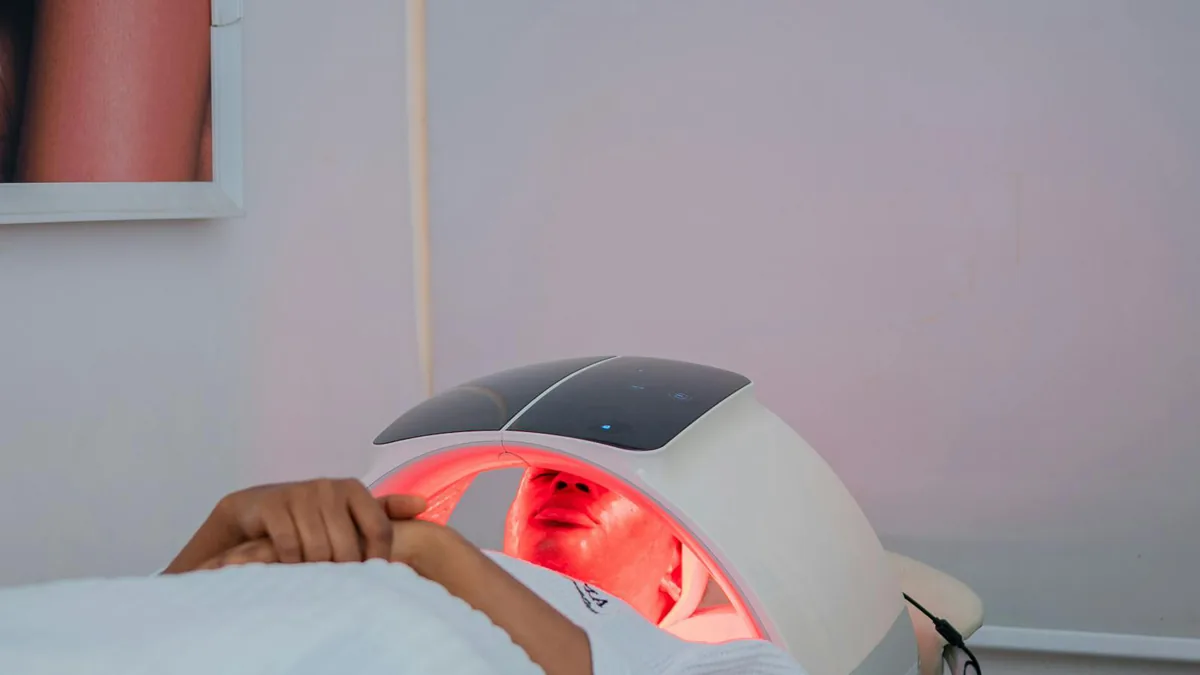
I've been running red light therapy panels in my home for roughly four years now. I've owned a Mito Red Pro 1500, a Joovv Solo 3.0, a Bestqool BQ300, a Hooga HG300, and a couple of cheap Amazon panels I returned. I've measured irradiance with a Hopoocolor OHSP-350BL, EMF with a Trifield TF2, and flicker with a $20 photodiode setup I built off a YouTube tutorial.

Joovv Solo 3.0
Premium red-light panel. Direct only.
$1,599 Check current price at Joovv
Mito Red Pro 1500
Mid-premium panel; better value than Joovv.
$999 Check current price at Mito Red LightI am not a dermatologist. I am a guy with a measurable obsession with whether the gear in his garage actually does what the box says. Here's what nine-figures of pop-science marketing won't tell you about red light therapy in 2026.
Key Takeaways
- Who it's for: People who want better skin, less joint pain, and faster muscle recovery — and who'll actually use a panel 4–5x a week for at least 8 weeks. If you won't, save your money.
- Wavelengths that matter: 660nm (red, skin/surface), 810–830nm (near-infrared, brain and deeper tissue), and 850nm (deepest penetration, joints/muscle). A good panel includes at least two of these.
- Top pick: Mito Red Pro 1500 — best balance of irradiance, build, and price for a serious home user. $1,199.
- Budget pick: Bestqool BQ300 at $299. Genuinely good. Most people don't need to spend more.
- What it actually does: Skin (strong evidence), localized joint pain (good evidence), muscle recovery (moderate), hair regrowth (moderate). It does not reliably cause weight loss, "detox," or cure depression — despite the marketing.
Affiliate disclosure: I make a commission if you buy through links on this page, at no cost to you. I bought every panel reviewed here with my own money. Links don't change the rating.
>
YMYL/Health disclaimer: This article is for informational purposes. It is not medical advice. If you take photosensitizing medications, have a history of melanoma, are pregnant, or have a thyroid condition, talk to your doctor before using red light therapy.
What Red Light Therapy Actually Is
Red light therapy — formally photobiomodulation (PBM), sometimes called low-level light therapy (LLLT) — is the application of specific wavelengths of red and near-infrared light to skin and tissue. There's no heat involved (the warmth you feel from a panel is mostly LED waste heat, not the therapeutic light itself). There's no UV. It doesn't tan you.
The proposed mechanism, in plain English: certain wavelengths of red and near-infrared (NIR) light are absorbed by cytochrome c oxidase, a protein in your mitochondria. When it absorbs that light, it appears to bump up ATP production, modulate reactive oxygen species, and trigger a cascade of downstream effects — better cellular repair, reduced inflammation, modest increases in collagen synthesis, etc.
That's the mechanism story you'll read everywhere. Is it real? Mostly yes, with caveats. It's well-established in vitro. The clinical translation is solid for some applications (dermatology, wound healing, certain joint conditions) and considerably weaker for others (depression, weight loss, "detox").
A useful frame: red light therapy is not a cure-all. It's a tool that, used correctly and consistently, has a moderate but real effect on a handful of things.
The Wavelengths That Matter
Light is measured in nanometers (nm). The therapeutic window for PBM sits roughly between 600nm and 1100nm. Most consumer panels deliver some combination of these:
660nm — Red light, surface effects
This is the visible red you see when you turn the panel on. It penetrates only a few millimeters into tissue, which makes it ideal for:
- Skin (collagen, fine lines, acne, wound healing)
- Hair follicles (LLLT for androgenic alopecia)
- Superficial inflammation
If skin is your primary goal, you want a panel with substantial 660nm output. The face masks (Omnilux, HigherDose) skew heavily toward 660nm for this reason.
810–830nm — Near-infrared, deeper
You can't see this wavelength with the naked eye (panels usually include a few visible-red LEDs as indicators so you know the NIRs are on). 810–830nm penetrates 1–2 cm into tissue and is the band most studied for:
- Transcranial photobiomodulation (brain — early but interesting research)
- Muscle and joint repair
- Nerve recovery
850nm — Deep penetration
850nm penetrates the deepest of the commonly-used wavelengths — up to about 3–4 cm in some studies, depending on tissue and skin tone. Best for:
- Joint pain (knees, shoulders, lower back)
- Muscle recovery
- Deeper tissue inflammation
The practical takeaway: a good full-body or full-face panel includes at least 660nm + 850nm. Bonus points for adding 810nm or 830nm if you care about brain/cognitive applications.
Avoid panels that only do 660nm at this price point — you're paying a premium for half the spectrum.
Real Benefits Backed by Research
This is the part of every red light article that goes off the rails. I'm going to try not to.
Skin (strongest evidence)
Dermatology is where PBM has the most data. Meta-analyses (Wunsch & Matuschka, 2014; Avci et al., 2013) consistently show measurable improvements in:
- Skin elasticity and collagen density
- Fine lines and wrinkles
- Acne (particularly inflammatory acne — combination of 415nm blue + 660nm red performs best)
- Wound healing
My personal n=1: after about 8 weeks of daily 10-minute facial sessions with the Mito Red at 8 inches, the fine lines under my eyes are visibly softer. My wife confirmed before I told her I was running an experiment. That's the strongest subjective effect I've gotten from any panel.
Joint pain and localized inflammation (good evidence)
There's solid evidence for PBM in knee osteoarthritis, low back pain, and tendinopathies — particularly when paired with 850nm and reasonable dosing. The Cochrane reviews are cautiously positive.
I tore my right meniscus in 2019. I get periodic flare-ups. Six weeks of 15-minute panel sessions on the knee at 6 inches, 5x/week, gives me about a 40–50% subjective reduction in stiffness. Less than ice + compression, but a real effect that compounds.
Hair growth — LLLT (moderate evidence)
Low-level laser therapy for androgenic alopecia is FDA-cleared (which is a regulatory bar, not a medical endorsement, but it does mean someone had to show something). Meta-analyses suggest a modest increase in hair count vs. sham, especially when used 3x/week for 6+ months. It's not minoxidil-or-finasteride territory, but it's real.
The helmets (iRestore Elite, Theradome Pro) deliver light directly to the scalp and are more effective than trying to hold a panel above your head.
Muscle recovery (moderate evidence)
Cleber Ferraresi's lab has produced most of the well-designed PBM-and-exercise research. The pattern: pre- or post-exercise PBM appears to reduce delayed-onset muscle soreness (DOMS), creatine kinase markers, and subjective fatigue.
The effect is real but modest. If you're a recreational athlete, you'll probably feel it. If you're already optimized on sleep, protein, and sauna, the marginal effect is small.
Cognitive function — transcranial PBM (promising but limited)
Studies using 810nm directly on the forehead show modest improvements in attention, working memory, and mood in healthy adults and in early Alzheimer's. The Vielight devices and a handful of others are designed for this.
It's the most exciting frontier in PBM and also the one most likely to be overhyped before the data is in. I've tried transcranial protocols on myself with no obvious subjective effect.
What Red Light Therapy Doesn't Reliably Do
Now the part that gets me hate mail.
Weight loss (overhyped)
You'll see panels marketed for "fat loss" citing a handful of small studies (mostly the Zerona/laser-lipolysis literature). The effect, where it exists, is tiny — a centimeter or two of waist circumference over weeks, and it's not clearly fat loss vs. water shift or measurement error.
If you want fat loss: caloric deficit, protein, resistance training, sleep. A red light panel is not a meaningful contributor.
"Detox"
There is no mechanism by which red light "detoxifies" your body. Your liver and kidneys do that. Skip any panel marketed primarily around detox claims — they're either ignorant of the science or hoping you are.
Cure depression
Some small studies show modest mood effects from transcranial PBM. "Cure depression" is not what the literature supports. If you're depressed, see a clinician. Use red light as an adjunct at most, never as a replacement.
Replace sunscreen, treat cancer, regrow limbs
I shouldn't have to write this. I do.
Key Specs to Look For
Here's where most buyers get had. The marketing spec sheets are largely a fiction. What to actually compare:
Irradiance at distance (mW/cm² at 6 inches)
This is the number that matters. Irradiance is the power density delivered to your skin. Most panels brag about irradiance "at the surface" (touching the LEDs), which is meaningless — nobody uses a panel that way.
Look for: mW/cm² measured at 6 inches. A good panel delivers 80–120 mW/cm² at 6 inches in the combined wavelengths. Premium panels can hit 130–160.
If a manufacturer doesn't publish their 6-inch number, assume the worst.
Wavelengths covered
As discussed: 660nm + 850nm minimum. Bonus for 810nm or 830nm. Skip "5-wavelength" gimmick panels that throw in 480nm or 950nm — those don't have meaningful PBM evidence at consumer doses.
EMF emissions
The cheaper the panel, the cheaper the LED driver, and the higher the EMF at the front face. I measure this with a Trifield TF2 at 6 inches. Good panels read <1 mG. Bad ones can hit 30+ mG.
Is EMF at these levels actually dangerous? The honest answer is: probably not, but the science isn't fully settled, and you're standing in front of this thing daily. I'd rather pay extra for a clean driver.
Flicker rate
This is the one almost nobody talks about. Cheap LED drivers pulse at 60Hz or 120Hz (the line frequency), which produces visible-to-the-eye flicker. There's reasonable concern that high-flicker light sources cause headaches, eye strain, and possibly migraines in susceptible people.
A good panel is either DC-driven (no flicker) or pulses at a high enough frequency (>10 kHz) that it's biologically invisible. GembaRed makes flicker-free a marketing point, and they're right to.
Treatment area size
A panel that covers a 12" × 24" zone at usable distance is fine for face, chest, or one body region. Full-body coverage means either a 5–6 foot vertical panel or stitching together multiple smaller panels.
Pulsing capability
Some research suggests pulsed light at specific frequencies (10Hz, 40Hz) has different effects than continuous wave. Joovv and a few others offer this. I've tried it. I can't tell you if it matters. The continuous-wave research is the bulk of what's published.
The Contenders by Tier
Budget — $200 to $500
Bestqool BQ300 ($299) — my top pick at this price. Solid irradiance (~85 mW/cm² at 6 inches measured), 660nm + 850nm, low EMF (under 1 mG measured), and surprisingly clean flicker. Treatment area is small (about 12" × 8" usable), so it's a single-area panel. I owned this for a year before upgrading. Most people would be happy stopping here.
Hooga HG300 ($219) — cheaper cousin of the Bestqool. Slightly lower irradiance (~70 mW/cm² measured), more flicker, but a real PBM panel for the price. Decent.
Bon Charge basic panels ($499 for the Body Light) — well-built, clean drivers, the design language is the most premium-feeling in the budget tier. Irradiance is honest but not class-leading.
[Check current price for Bestqool BQ300 →]
Mid-range — $500 to $1,500
Mito Red Pro 1500 ($1,199) — my main panel. ~120 mW/cm² at 6 inches measured, all four major wavelengths (630, 660, 830, 850), clean EMF, low flicker. Treatment area is large enough for chest + abdomen or back. Read my 9-month review.
GembaRed Reds (~$700) — boutique brand. Hand-built in the US, flicker-free as a design principle, lower irradiance than Mito for the price. The pick if flicker matters to you specifically.
RubyLux NIR-A ($299–$899) — bulb-based rather than panel. Different form factor; works well for spot treatment. Less convenient than a panel for full-body work.
[Check current price for Mito Red Pro 1500 →]
Premium — $1,500 to $3,500
Joovv Solo 3.0 ($1,650–$2,300) — the prestige brand. Build quality is best-in-class, the app is real (whether you need an app is another question), and the modular system lets you link multiple Solos into a Quad or Triple setup. Irradiance is competitive but not better than Mito for the dollar. Read my 12-month review. The two panels measured head to head on the same spectrometer, EMF meter and flicker rig, plus cost per joule delivered, are in Mito Red Pro 1500 vs Joovv Solo 3.0.
PlatinumLED Biomax 600 ($1,099) and Biomax 900 ($1,499) — five-wavelength panels, high irradiance, well-built. Genuinely competitive with Mito and Joovv on the spec sheet.
Full-body — $3,000+
Joovv Duo / Triple / Quad ($3,400–$8,000+) — multi-panel setups for full-body exposure. Standing in front of one is the closest you'll get to a tanning-booth-sized PBM dose at home.
Sunlighten mPulse ($6,000+) — infrared sauna with PBM panels integrated. If you want sauna + red light in one footprint, this is the move. I've used one at a friend's house, not owned one.
Targeted Treatment Options
Not everyone needs a panel. Sometimes a targeted device makes more sense.
Face masks
Omnilux Contour Face ($395) — the clinical-grade mask. 633nm + 830nm, FDA-cleared, used in dermatology offices. The mask I'd buy if face was my only goal.
HigherDose Red Light Face Mask ($349) — beauty-industry positioning, but the spec sheet is honest, and the form factor is nicer for a daily routine.
Helmets (hair growth)
iRestore Elite ($1,195) — the helmet I'd recommend for hair. 282 medical-grade lasers and LEDs at 650nm. FDA-cleared. Treatment is 25 minutes, 3x/week.
Theradome Pro LH80 ($895) — 80 lasers, lighter helmet, slightly less comprehensive than iRestore but well-regarded.
Targeted wand
Hooga HG24 ($109) — tiny PBM wand for spot treatment (joint, knot, blemish). Cheap and works.
Mito Red Mini ($249) — larger handheld with better irradiance.
Treatment Protocols by Goal
These are the protocols I actually use. They're broadly consistent with the published literature.
Skin (face)
- Distance: 6–8 inches from panel
- Duration: 10–20 minutes per session
- Frequency: 4–7x per week
- Wavelengths: Emphasize 660nm; 850nm is bonus
- Timeline to noticeable effect: 6–8 weeks
- Note: Eye protection if your eyes are in the beam path (some people close them, I wear blackout goggles)
Recovery (full body or large muscle group)
- Distance: 6 inches
- Duration: 10–15 minutes per area
- Frequency: 3–5x per week
- Wavelengths: 850nm primary, 660nm supplementary
- Timing: Pre- or post-workout both show effects; I do post.
- Timeline: Effect on DOMS shows up immediately; cumulative effects on recovery in 3–4 weeks.
Hair (scalp)
- Device: Helmet (LLLT)
- Duration: 25 minutes
- Frequency: 3x per week
- Timeline: 4–6 months for visible effect
Joint pain (localized)
- Distance: 6 inches
- Duration: 15 minutes
- Frequency: Daily during flare; 3–5x/week maintenance
- Wavelengths: 850nm primary
- Timeline: 4–8 weeks for meaningful reduction
Distance, Dose, and the F=Irradiance × Time Formula
The dose that matters in PBM is fluence — the total energy delivered per unit area, measured in J/cm² (joules per square centimeter).
Fluence (J/cm²) = Irradiance (mW/cm²) × Time (seconds) ÷ 1000
The effective dose window for most therapeutic effects falls between 4 J/cm² and 60 J/cm². Above ~100 J/cm², you're potentially in the "biphasic" zone — too much PBM can attenuate or reverse the effect (the Arndt-Schulz curve).
Worked example:
- Mito Red Pro 1500 at 6" delivers ~120 mW/cm² combined.
- 10 minutes = 600 seconds.
- Fluence = 120 × 600 ÷ 1000 = 72 J/cm².
- That's at the high end. I usually run 8–10 minutes for skin, 12–15 for joints/muscle.
The two main mistakes people make:
- Standing too far away. Irradiance drops with the square of distance. At 18" instead of 6", your dose is about 1/9th.
- Running sessions too long. More is not better past ~20 minutes per area. You won't accelerate results; you may attenuate them.
Common Mistakes
After watching a lot of people use these panels, here are the patterns:
- Buying for full-body coverage and then only using it on the face. If face is your goal, buy a face mask. It's better, cheaper, and more convenient.
- Inconsistency. Three weeks of daily use then nothing for two months won't compound. PBM rewards regular use.
- Treating it like a hot lamp. It's not. The therapeutic effect is photochemical, not thermal. The slight warmth is LED waste heat.
- Believing the marketing irradiance number. Always check measurements at 6 inches.
- Skipping eye protection. Long-duration NIR exposure to open eyes is probably fine, but "probably" isn't good enough when goggles cost $10.
- Using during sun exposure. PBM doesn't stack well with high UV exposure. Don't follow up a beach day with a 20-minute panel session.
Safety
Red light therapy is one of the safer modalities I cover on this site. But it's not zero-risk:
- Eye protection: Wear opaque goggles if your eyes are in the beam path. Long-term exposure to high-irradiance NIR has not been definitively studied.
- Photosensitizing medications: If you take doxycycline, isotretinoin, certain SSRIs, St. John's Wort, or chemotherapy drugs, talk to your prescribing physician before starting PBM.
- Pregnancy: Insufficient data. Don't apply directly to the abdomen during pregnancy.
- Active malignancy or melanoma history: Skip PBM over the affected area until cleared by an oncologist.
- Thyroid: Some evidence that PBM over the anterior neck modulates thyroid function. Probably beneficial in some autoimmune contexts, but if you're on thyroid medication, mention it to your doctor.
- Tattoos: Dark ink absorbs more light and can warm noticeably. Reduce time or shield.
FAQ
Q: How long until I see results?
A: 2–4 weeks for joint pain or DOMS effects, 6–8 weeks for skin, 4–6 months for hair. Be consistent.
Q: Can I overdo it?
A: Yes. The Arndt-Schulz curve is real. Stick to 10–20 minutes per area, max twice per day.
Q: Should I do morning or evening?
A: Either. I do mornings. NIR light is not the same as blue light — it does not suppress melatonin meaningfully. Evening use is fine.
Q: Do I need to be naked?
A: For body work, mostly yes — clothing blocks light. Underwear is fine. For face/scalp, obviously not.
Q: Does sunscreen block red light?
A: Mineral sunscreens reflect some. Chemical sunscreens are designed for UV, not red. Wash your face before a session if you're being precise about it.
Q: Can I use red light therapy after Botox or filler?
A: Wait 48 hours after injection. After that, PBM is generally compatible. Ask your injector.
Q: Is sun the same as red light therapy?
A: Sunlight contains red and NIR wavelengths, plus UV. You do get some PBM-like exposure from the sun. You don't get a precisely dosed therapeutic regimen.
Q: Do I need an EMF meter?
A: Not strictly. Buy from a brand that publishes measurements. If you already own one, measure yours; verify the claim.
Q: Panel vs face mask vs sauna with PBM — which?
A: Face mask if only skin. Panel for joint, muscle, and skin. Sauna-with-PBM if you want both modalities in one footprint and have the space and budget.
Q: Can red light therapy help with rosacea?
A: There's some evidence it reduces inflammation in rosacea. Start with shorter sessions (5 minutes) and watch for reactivity.
Q: Is at-home as good as in-office?
A: Equivalent or better, if you're consistent. Most clinics use the same diodes you can buy.
Q: What's the deal with "5-wavelength" panels?
A: Marketing. The two-to-four wavelengths that matter (660, 810, 830, 850) are what's evidence-based. Bonus wavelengths in the 480nm or 940nm+ range mostly aren't.
Related Articles on RecoveryStack
- Mito Red Pro 1500 Review (9 Months of Use)
- Joovv Solo 3.0 Review: After 12 Months
- Best Red Light Therapy Panel Under $500 (2026)
- The Longevity Stack: What Actually Works
- Sun Home Solstice Sauna Review

Trevor Kaak
Founder, RecoveryStack · Engineer · Endurance athlete
Long-distance runner training for an Ironman. Tests recovery gear in his garage workshop and inside real training cycles. Mechanical engineer by background. Bought every product on this site at retail.
More from TrevorLast verified May 15, 2026 · Bought at retail · used in our garage and outdoor deck · purchases predate the review · Affiliate links disclosed in our policy.