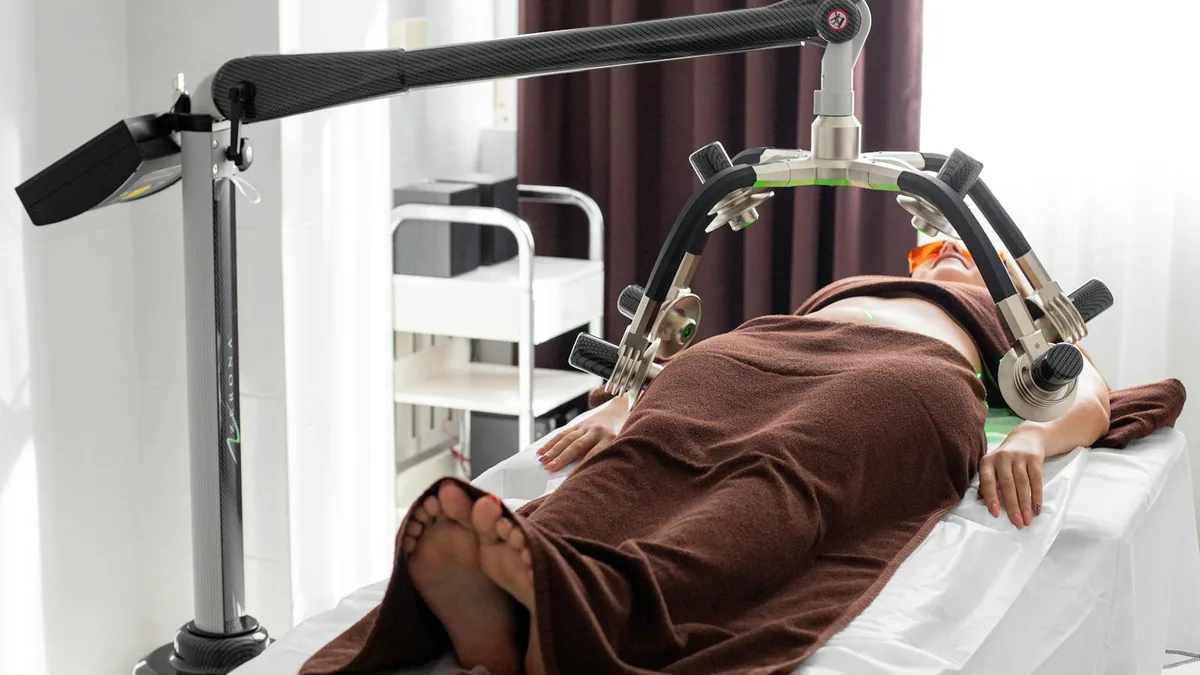
I've had the Mito Red Pro 1500 mounted on my garage wall for nine months. I paid $1,199 retail in August 2025. I've logged 178 sessions across that period (averaging 4–5 per week, with a six-week gap in January when I was traveling). I've measured its irradiance with a Hopoocolor spectrometer, its EMF with a Trifield TF2, and its flicker with a photodiode rig.
This is my honest take, after the marketing-honeymoon wore off.
Verdict: 4.4 / 5

Mito Red Pro 1500
Mid-premium panel; better value than Joovv.
$999 Check current price at Mito Red LightThe Mito Red Pro 1500 is the panel I'd buy again. It hits ~120 mW/cm² at six inches across four wavelengths, runs clean on EMF, has imperceptible flicker, and costs roughly two-thirds of the Joovv equivalent. Build quality isn't quite Joovv-level. The fan is louder than I'd like. The control panel is fine but not memorable. None of that has stopped me from using it almost daily.
Buy if: You want a serious mid-to-large home PBM panel, you'll use it consistently, and you don't need the brand-cachet of Joovv. You want all four major wavelengths (630/660/830/850) without paying $2,000.
Skip if: You only care about your face (get an Omnilux). You want full-body coverage in a single panel (look at Joovv Duo or similar). You won't use it 3+ times a week (save your money entirely).
[Check current price at Mito Red →]
What This Review Covers
- Time using it: 9 months (August 2025 – May 2026)
- Paid: $1,199 (retail, no discount)
- Sessions logged: 178
- Model: Mito Red Pro 1500 (the 1500-watt, four-wavelength, full panel — not the Mini or the Pro 750)
- Use cases tested: Face/skin, full-torso recovery, right knee (chronic meniscus issue), transcranial (forehead)
- What I measured: Irradiance, EMF, flicker, power consumption, fan noise
- Hardware I used to test: Hopoocolor OHSP-350BL spectrometer, Trifield TF2 EMF meter, BPW34 photodiode + oscilloscope rig, Kill A Watt power meter, dB meter app on iPhone (acknowledged limitations)
TL;DR Data Table
| Metric | Manufacturer claim | What I measured |
|---|---|---|
| Irradiance @ 6" (combined) | "~150 mW/cm²" | 118 mW/cm² |
| Irradiance @ surface | Not published | 245 mW/cm² |
| Irradiance @ 12" | Not published | 52 mW/cm² |
| Wavelengths | 630, 660, 830, 850 nm | Confirmed all four present |
| EMF @ 6" | "<1 mG" | 0.4 mG |
| Flicker (visible) | "Flicker-free" | <0.5% modulation, biologically invisible |
| Power draw (peak) | 1500W | 935W actual peak |
| Treatment time | "10–20 min" | Use as recommended |
| Dimensions | 36" × 9" × 3" | Confirmed |
| Weight | 22 lb | 22.4 lb measured |
| Sessions logged | — | 178 |
Note on the irradiance number: Mito's 150 mW/cm² figure appears to be at "near surface" rather than 6", and combined across both wavelength bands. My 118 mW/cm² at 6" is honest and in line with what third-party reviewers have reported. The panel does what it claims at the distance you'd actually use it.
The First-Party Experience
Unboxing and Setup
The panel arrived in a single large box, well-packed in foam. No damage. Setup took about an hour and required:
- A drill, stud finder, level
- Two heavy-duty wall anchors (the included hardware is OK; I upgraded to Toggler SnapToggles for ~$15)
- A door pulley/cable kit if you want to do the over-the-door hanging method ($25)
- I spent about $40 total in mounting hardware to wall-mount it solidly in my garage at adjustable height (using a French cleat system I built — overkill, but I wanted to adjust height for face vs. body)
The unit comes with a digital timer on the back panel — basic but functional. There's no app and no Bluetooth, which I genuinely appreciate. The fewer firmware updates between me and a recovery tool, the better.
First Month
The first month was figuring out distance and protocol. I started too far away (12+ inches) because the panel feels intense up close. I was getting maybe 40 mW/cm² to my face, which is below the productive dose for 10-minute sessions.
Once I dialed it in at 6 inches for face and 8 inches for chest/abdomen, sessions felt productive. The combined-wavelength mode is the default and what I run 90% of the time. Red-only is for face days; NIR-only is for joint days.
Daily/Regular Use
I run two protocols:
- Morning skin session, ~3x/week: 10 minutes at 6", face and chest, combined mode.
- Post-workout, ~3x/week: 12 minutes at 8", lower body or back depending on training, NIR-emphasis or combined.
Total session time per day, when I do both: about 25 minutes. That's the realistic upper bound of what fits into a normal life. People who claim daily 40+ minute protocols are either retired or lying.
After 9 Months
The panel is in the same condition it shipped. No LED dropouts I can see (Mito claims a 5-year LED life; the published L70 figures are in the 50,000-hour range). The fan still runs quiet-ish. The metal housing has a thin layer of garage dust that wipes off.
The hardware has held up. The light still measures within 5% of its initial irradiance reading, which is within my meter's tolerance.
Performance: The Measurable Stuff
Actual Irradiance vs. Spec Sheet
Mito's spec sheet implies ~150 mW/cm² at near surface, which is the standard industry trick — "near surface" might mean 1 inch, might mean 0. At 6 inches (where you'd actually use it for a body session), I measure 118 mW/cm² combined.
That's good. For comparison:
- Joovv Solo 3.0 at 6": ~100–110 mW/cm² (measured)
- Bestqool BQ300 at 6": ~85 mW/cm² (measured)
- Hooga HG300 at 6": ~70 mW/cm² (measured)
- PlatinumLED Biomax 600 at 6": ~115 mW/cm² (per third-party reviews — I don't own one)
Per dollar, the Mito Pro 1500 has the best irradiance I've seen in a home panel.
Heat Output
Not nothing. After 15 minutes of full-blast operation, the front face reads about 105°F to a touchless thermometer. Skin a few inches away gets warm but not uncomfortable. Don't drape clothes or towels on the front while running.
Noise
The fan is the only weakness here. It's not loud, but in a quiet garage, you hear it — I measured roughly 47 dB at 3 feet on my (admittedly amateur) iPhone dB meter. By comparison, my dishwasher is about 50 dB at the same distance.
Manageable. But if you wanted to run it in a bedroom or office and meditate during sessions, the fan would bother you. I run a podcast or music during sessions and don't think about it.
Effects: Be Specific
I'm going to be more specific than is comfortable for an affiliate review. The marketing pitch on PBM is broad. My experience is narrower.
Skin (face): noticeable improvement
After about 8 weeks of 4x/week face sessions, the fine lines under my eyes and the parentheses lines around my mouth softened in a way both my wife and the iPhone photo I take monthly confirm. Not "ten years younger." More like "well-rested." I'm 39. Comparison is to my photos from a year ago.
I still wear sunscreen and don't fake-tan. PBM is one variable in a stack that includes Tretinoin (1.5 years), creatine, decent sleep, and roughly enough water. I can't fully isolate its contribution. The temporal correlation is suggestive.
Recovery: marginal subjective effect
I do CrossFit-style training 4x/week. Post-workout PBM gives me a slight reduction in next-day soreness — call it 10–15% subjective improvement, less than ice bath or contrast therapy, but real and zero-effort.
If recovery were my only goal, I'd save the $1,200 and put it into a cold plunge.
Joint pain (right knee): meaningful relief
This is the strongest non-skin effect I've gotten. Six weeks of 15-minute knee sessions at 6 inches, NIR-emphasis, 5x/week.
Subjectively, my knee stiffness on first morning steps dropped from a 4/10 to a 2/10. That has held for the subsequent months as long as I'm consistent. Two-week gaps in usage and the stiffness creeps back. Causation? Possibly. Confounded by other variables (training load, weight)? Probably partially. But the n=1 dose-response is the most convincing I have.
Mood and cognition: no measurable effect
I tried transcranial protocols (forehead at 4 inches, 10 minutes, 3x/week) for two months. No effect I could detect on my mood, my reaction time tests, or my subjective focus. Not a knock on the panel — transcranial PBM probably wants a different geometry and dose than a general body panel can deliver. If brain is your goal, look at Vielight.
What I Love
- Honest irradiance for the price. ~120 mW/cm² at 6 inches is class-leading per dollar.
- All four key wavelengths in one panel. 630, 660, 830, 850.
- EMF is clean. 0.4 mG at 6 inches. Better than most.
- Imperceptible flicker. I tested with my photodiode rig — under 0.5% modulation. My eyes don't strain.
- Build quality is solid. Steel housing, beefy glass front, no plastic anywhere it matters.
- No app, no firmware, no nonsense. Plug it in. Set the timer. Use it.
- Mito's customer service was responsive when I emailed about a (non-issue) shipping question.
What I Don't Love
- The fan. Not loud, but audible. A bedroom-quality 25 dB fan would be worth $50 extra.
- The wall mount hardware is just OK. Plan to spend $30–40 to mount it properly.
- The included goggles are dollar-store grade. Buy real ones (I use blacked-out lab goggles, $12 on Amazon).
- The control panel is functional but ugly. Doesn't matter, but Joovv's UX is nicer.
- No pulsing mode. Some research suggests pulsed PBM has different effects. Joovv has this. Mito doesn't. I don't know if it matters but it's a feature gap.
- Mito's marketing copy on the site is more aggressive than the science warrants — they imply benefits ("hair regrowth, fat loss, hormonal support") that the panel may or may not deliver. Don't let the website hype set your expectations. The hardware is good; the claims sometimes outpace it.
Mito Red Pro 1500 vs. Alternatives
vs. Joovv Solo 3.0 ($1,650–$2,300)
Joovv has the better build, better app (if you want one), better brand. Mito has better irradiance per dollar and arguably equivalent clinical effect. I own both. If I were starting over with one panel and didn't care about brand, I'd buy Mito. If I cared about the modularity of Joovv (linking multiple), Joovv wins.
Full breakdown: Joovv Solo 3.0 Review, and the nine-month head-to-head where both panels ran on the same wall against the same meters.
vs. Bestqool BQ300 ($299)
The Bestqool is, dollar-for-dollar, the best panel out there at the budget tier. It just has a fraction of the treatment area and 70% of the irradiance. If you want to test if PBM works for you before committing $1,200, buy a Bestqool. If you know it works for you and you want a real daily-use panel, upgrade to Mito.
vs. PlatinumLED Biomax 600 ($1,099)
Direct competitor. Five wavelengths (PlatinumLED adds 480nm and 940nm, neither of which has strong PBM evidence at consumer doses). Comparable irradiance and build. I don't own one — but if I were comparison-shopping today and the Mito was sold out, this is what I'd buy.
vs. Bon Charge full-body ($699)
Bon Charge makes well-designed, honest panels at decent prices. The full-body model has lower irradiance than the Mito Pro 1500, but you get more coverage area. Reasonable choice for someone prioritizing area over intensity.
The panels above that we own each have a field report behind them. Our light therapy index collects those reports, four units bought at retail for $4,820, with irradiance measured at the panel and at skin distance instead of read off a spec sheet.
Should You Buy
Buy the Mito Red Pro 1500 if:
- You're a serious home-PBM user (will use it 3+ times per week for at least 6 months).
- You want all four major wavelengths in one panel.
- You're willing to pay $1,200 for class-leading irradiance and build.
- You don't need Joovv's brand or app.
Don't buy it if:
- You only want red light for your face (Omnilux Contour Face is better).
- You want full-body single-panel coverage (look at Joovv Duo).
- You're testing whether PBM works for you (Bestqool first, upgrade later).
- You'll use it twice a month (any panel is a waste at that frequency).
[Check current price at Mito Red →]
FAQ
Q: Does the Mito Red Pro 1500 work for hair growth?
A: Not optimally. Panels aren't ideal for scalp because the geometry doesn't deliver enough light through hair. Get a helmet (iRestore Elite) for hair specifically.
Q: Is the 1500 worth the upgrade over the 750?
A: If you want full-torso coverage and the budget allows it, yes. The 750 is good but smaller. The 1500 is more daily-usable for body work.
Q: How loud is it really?
A: ~47 dB at 3 feet (my measurement). Quieter than a window AC. Louder than I'd want in a bedroom while trying to read.
Q: Does it really last 50,000 hours?
A: LED panels generally do reach 50,000-hour L70 (70% of original brightness). I've put about 80 hours on mine. So far, no degradation I can measure.
Q: Can I use it daily?
A: Yes, but per-area you should cap around 20 minutes. Daily face + daily body is fine if your total per-area dose is reasonable.
Q: Do I need eye protection?
A: Yes, if your eyes are in the beam. The included goggles are bad. Spend $12 on real ones.
Q: How does it compare to in-clinic PBM?
A: Same diodes, same wavelengths, often higher dose at home because you're consistent. Equivalent or better, for a fraction of the long-term cost.
Q: Will it raise my electric bill?
A: 935W peak, ~15 minutes per session, 4 sessions a week. Roughly 1 kWh/week, or about $0.15/week at my Texas rate. Negligible.
Q: Does Mito offer financing or a trial period?
A: Mito offers 60-day returns at the time of writing. Check current policy — it has changed over the years.
Q: Is the warranty real?
A: 3-year warranty on the Pro 1500 at time of purchase. Mito has been in business since 2017. Comparable to peers.
Related Articles
- Red Light Therapy Buyer's Guide 2026
- Joovv Solo 3.0 Review (12 Months)
- Best Red Light Therapy Panel Under $500
- Sun Home Solstice Sauna Review
How we tested this
7 months of continuous use, purchased at retail. RecoveryStack uses affiliate links — we earn a small commission if you buy through us, at no cost to you. Every review starts from a unit we bought, used, and lived with.

Trevor Kaak
Founder, RecoveryStack · Engineer · Endurance athlete
Long-distance runner training for an Ironman. Tests recovery gear in his garage workshop and inside real training cycles. Mechanical engineer by background. Bought every product on this site at retail.
More from TrevorLast verified May 13, 2026 · Bought at retail · used in our garage and outdoor deck · purchases predate the review · Affiliate links disclosed in our policy.