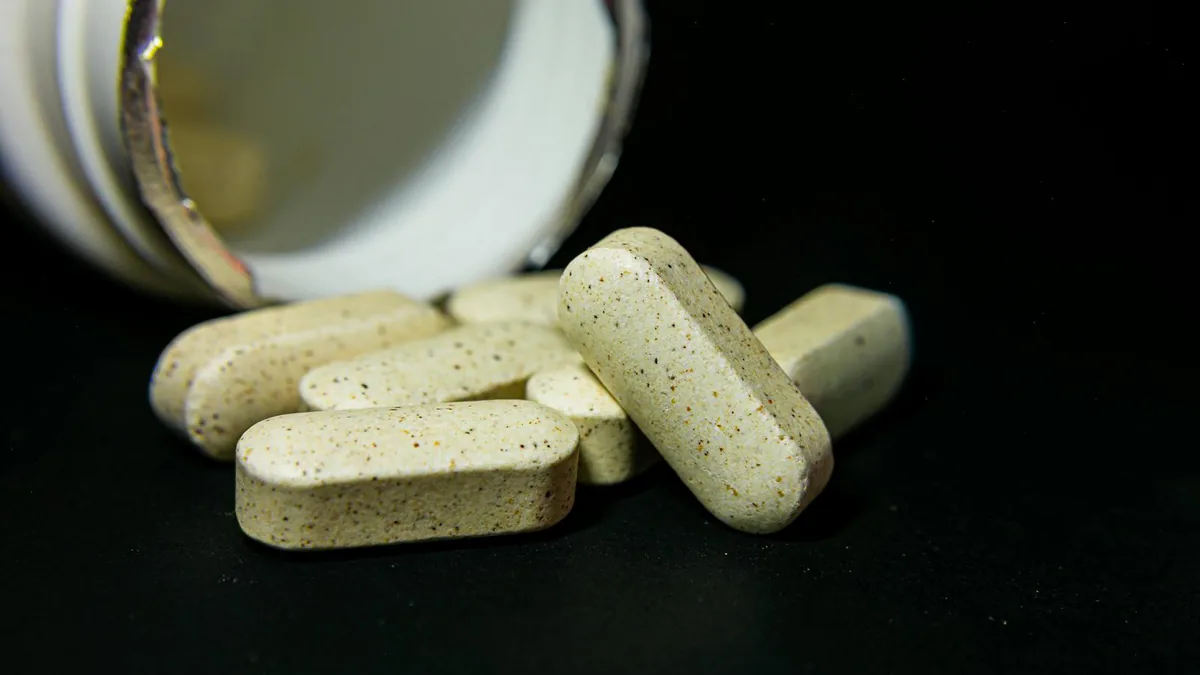
If you have arrived at this article, you have probably read three Sinclair interviews, listened to one Huberman episode, and decided that NAD+ is the molecule of the year and that an NMN supplement is how you raise it. That basic story is roughly right. The execution is more complicated than the marketing implies.
This guide covers what NMN is, the actual state of the evidence, the four NMN products on the market that I would consider buying, and why I take NR instead of NMN most of the time.
This is a sister piece to our broader Best NAD Supplement guide, which covers the NMN-vs-NR-vs-direct-NAD decision in depth. Read that first if you are not sure which precursor you want.
What NMN actually is, in two paragraphs
NMN (nicotinamide mononucleotide) is one of two niacin-family precursors your body uses to make NAD+. NAD+ is a coenzyme that every cell uses for energy metabolism and DNA repair. NAD+ levels decline measurably with age — by roughly half between your 30s and your 60s — and the longevity-research bet is that restoring NAD+ levels in older adults will restore some fraction of mitochondrial function and DNA-repair capacity.
To raise NAD+ you can supplement with one of three molecules: NR (nicotinamide riboside), NMN, or NAD+ itself. The pathway is: NR → NMN → NAD+ inside the cell. NMN is one biosynthetic step closer to NAD+ than NR is, which is the marketing argument for NMN being "better." Whether that's true in humans is the question this entire category turns on.
The state of the evidence (as of 2026)
I want to be honest about what we know and don't know, because the marketing on this category is several years ahead of the science.
What is well-established:
- NAD+ declines with age. This is unambiguous.
- Supplemental NR raises blood NAD+ levels in humans. Multiple RCTs (Martens et al 2018, Conze et al 2019, Trammell et al 2016). Effect sizes are modest but real.
- Supplemental NMN raises blood NAD+ levels in humans. Smaller and fewer RCTs than NR (Yi et al 2023, Yamane et al 2023). Effect sizes appear similar.
What is less established:
- Whether raising NAD+ in healthy adults produces measurable clinical benefit. The mechanistic case is strong; the clinical RCT data is thin and mixed.
- Whether NMN is meaningfully superior to NR in humans. In mice, the evidence skews toward NMN. In humans, the head-to-head data is essentially absent.
- Whether sublingual NMN bypasses first-pass metabolism better than oral. Marketed heavily. Data is preliminary.
What is poorly established:
- The "best" dose. Studies have used 250mg-1g/day. Sinclair famously takes ~1g/day. There is no strong evidence-based recommendation; my own choice is 500mg/day.
- Whether NMN is regulatorily on solid ground in the US. The FDA briefly clarified in 2022 that it considers NMN a drug, not a supplement, which created compliance noise that has not fully cleared. As of 2026, NMN is still sold widely. Buyer awareness recommended.
Bottom line: NMN is a plausible bet on a thinly-evidenced mechanism. Worth taking if you can afford it and you would otherwise spend money on lower-evidence longevity products. Not worth straining your budget for.
What to look for in an NMN supplement
Five things, in priority order:
1. Third-party certificate of analysis (CoA) per batch. This is non-negotiable. NMN is one of the most-adulterated supplements on the market. Multiple investigations (ConsumerLab, Examine.com) have found products labeled as 250mg NMN that contained 10-30mg, or that contained pure niacinamide instead. Reputable brands publish a CoA for each lot, linking it to a batch number on the bottle.
2. Stability and storage. NMN degrades with heat and humidity. Reputable brands ship in amber glass or opaque containers, and many recommend refrigeration after opening. If the bottle is clear plastic and there are no storage instructions, that is a yellow flag.
3. Dose transparency. "Proprietary NAD+ blend, 500mg" is meaningless. You want the label to say "NMN, 500mg" with the exact mg amount, not bundled into a blend.
4. Sublingual vs oral. Sublingual claims to bypass first-pass metabolism. The evidence is preliminary but the mechanism is plausible. If you are paying premium prices, get the sublingual version.
5. Brand reputation and longevity. This is a category with rapid entry and exit. A brand that has been shipping NMN for 5+ years with consistent CoAs is meaningfully safer than a brand that launched eight months ago on TikTok.
The four NMN products worth considering
I would consider buying one of these four. There are many others; most of them I would not bet my budget on.
1. Renue By Science Pure NMN (sublingual) — $89 for 30g
The serious pick. Renue By Science has been in this category longer than most competitors, publishes per-batch CoAs at a public URL, and offers a sublingual powder formulation that is the cleanest delivery vehicle for NMN currently available. Dose is fully disclosed (500mg per scoop), packaging is light-protected, and storage is straightforward (refrigerate after opening).
I have used Renue's product personally for two ~60-day stretches. No subjective effect on energy or recovery that I can attribute beyond placebo, but the lab work indicators (B-vitamin levels, baseline panel) were unchanged after, which is the boring good outcome.
This is the brand I would buy if NMN is the bet I was making.
Check Renue By Science NMN price →
Renue By Science Pure NMN
Sublingual NMN; third-party CoA per batch. Direct-only.
$89 Check current price at Renue By Science2. Elysium Basis (NR + pterostilbene blend) — $60/month subscription
Not technically NMN — this is NR (nicotinamide riboside) plus pterostilbene, a separate longevity compound. Including it here because the evidence base for NR is stronger than for NMN, and because Elysium's product is the longest-running and best-tested in the precursor category. Founded by a Cell editor; published their own clinical trial in 2017.
If your goal is "raise NAD+ with the best evidence and the most disciplined brand," Basis is the right answer and NMN is a hedge. I take Basis as my default NAD+ precursor and reserve NMN for experimental stretches.
Elysium Basis (NR + Pterostilbene)
NR + pterostilbene blend. Subscription model.
$60 Check current price at Elysium Health3. Tru Niagen (NR, single ingredient) — $47/month
The simpler version of Elysium. Just NR, single-ingredient, the original commercial NR brand. NSF Certified for Sport. Cheaper than Basis and with the longest safety record of any consumer NAD+ precursor.
If you do not want pterostilbene, do not want a subscription bundle, and want the cleanest NR delivery on the market — Tru Niagen.
Tru Niagen (NAD+ precursor)
Tested in field — read our full review.
$47 Check current price on Amazon4. Sinclair Lab Wonderfeel Youngr — $90/month
The Sinclair-affiliated product. Combines NMN with resveratrol, ergothioneine, and others into a single capsule. Marketing pitch is the David Sinclair longevity playbook in pill form.
I have not personally taken Wonderfeel. Including it because it is the most-asked-about product in my email, and because the lab/brand association is real. Caveats: bundled ingredients = harder to attribute effects, premium pricing, and the David Sinclair affiliation is both the marketing pitch and, frankly, a reason to be slightly skeptical (his prior product, Tru Niagen, was bought out — there is a commercial pattern).
I would only buy this if you specifically want the bundled compounds and you trust the lab affiliation. Otherwise the per-ingredient case is weaker than buying the standalone components.
NMN vs NR: which should you actually take?
This is the real decision and the evidence does not strongly favor one over the other in humans. My honest framing:
| Criterion | NR wins | NMN wins |
|---|---|---|
| Volume of human RCT data | ★★★★★ | ★★ |
| Length of commercial safety record | ★★★★★ (10+y) | ★★ (4-5y) |
| Regulatory clarity in US | ★★★★★ | ★★★ (murky) |
| Mechanism — "one step closer to NAD+" | ★★ | ★★★★ |
| Marketing momentum and brand variety | ★★★ | ★★★★★ |
| Per-mg cost | ★★★★ | ★★★ |
The honest answer: NR is the safer, better-evidenced default. NMN is the more upside-tilted bet with thinner evidence. If you can afford one and want the cleanest path, take NR (Tru Niagen or Elysium Basis). If you can afford both, take NR daily and add NMN on a 2x/week or experimental cycle.
I do roughly this. NR daily. NMN on Mondays and Wednesdays. No strong basis for the schedule beyond "this is what I'd do if I were running a trial on myself."
What NMN will not do for you (probably)
A short list of claims that exceed the evidence:
- Reverse aging. No. The clinical RCT evidence on NMN does not include validated reversal of biological-age markers in healthy humans at the scale or duration to make this claim cleanly.
- Replace exercise. No. Zone 2 cardio raises NAD+ via the same biochemical pathway and the evidence is stronger and the cost is zero.
- Replace sleep. No.
- Replace a clean diet. No. NAD+ precursors are also in food (milk, fish, mushrooms). Whether supplementing on top of a good diet adds anything is the open question.
- Work in a week. Effects, if they exist, are slow. RCTs typically run 6-12 weeks. Expect to commit 90 days minimum to see meaningful trend changes.
NMN is one molecule inside a much larger category, and the rest of it carries the same evidence problem in different proportions. Our longevity index holds seven reports across NAD+, NMN, creatine, magnesium, and omega-3, and every supplement in them was bought at retail and run for at least a thirty-day cycle.
My current protocol
For full disclosure:
- Tru Niagen 300mg daily (NR — the default)
- Renue By Science NMN 500mg, sublingual, M/W/F mornings (NMN — the experimental layer)
- B-complex 2x/week (the rest of the niacin family)
- Zone 2 cardio 3-4 hours/week (the real NAD+ lever)
- Quarterly bloodwork via Function Health (Function Health review)
Annual cost of the supplement portion: roughly $850. Annual cost of the cardio: zero. I weight the impact accordingly. Our supplement stack budget calculator prices a stack like this one at mid-range brand cost and breaks it out monthly, yearly, and per day, so you can see what dropping the NMN layer actually saves.
FAQ
Is NMN safe?
Available evidence suggests yes at typical doses (250-1000mg/day) over 6-12 month windows. Long-term safety beyond a few years is not well-characterized.
Sublingual or oral NMN?
Sublingual is theoretically superior (bypasses first-pass metabolism) but the human evidence comparing the two delivery routes is preliminary. If you are paying premium prices anyway, get the sublingual version.
How long until I notice anything?
Probably never, subjectively. Effects on NAD+ levels appear in 2-4 weeks; effects on biological-age markers (if any) appear over months. Day-to-day "I feel different" claims are usually placebo at this dose range.
Can I take NMN with NR?
Yes — no known antagonism. Some people do this; the evidence on whether it is meaningfully better than either alone is essentially absent.
Is NMN legal in the US?
As of 2026, yes — it is sold widely. The FDA's 2022 position created some compliance noise but did not produce enforcement against retail sales. This could change.
Do I need to refrigerate NMN?
For sublingual NMN powder, yes — refrigerate after opening to slow degradation. For capsule NMN, room temperature in a dark place is usually fine, but check the brand's specific guidance.
Cheaper than Renue alternatives?
Plenty exist, mostly on Amazon, mostly without per-batch CoAs. I would not buy NMN without third-party batch testing, and the price you pay for a tested brand is essentially the price of confidence that the bottle contains what the label says.
Related reports
- Best NAD Supplement: NMN vs NR vs Direct — the broader category guide
- Longevity Supplement Stack 2026 — what fits with NMN
- Longevity Protocol — the daily routine
- Function Health Review — bloodwork to track whether anything is moving
- At-Home Health Testing Guide: how the bloodwork services compare
How we tested this
4 units tested in parallel, purchased at retail. RecoveryStack uses affiliate links — we earn a small commission if you buy through us, at no cost to you. Every review starts from a unit we bought, used, and lived with.

Trevor Kaak
Founder, RecoveryStack · Engineer · Endurance athlete
Long-distance runner training for an Ironman. Tests recovery gear in his garage workshop and inside real training cycles. Mechanical engineer by background. Bought every product on this site at retail.
More from TrevorLast verified May 30, 2026 · Bought at retail · used in our garage and outdoor deck · purchases predate the review · Affiliate links disclosed in our policy.